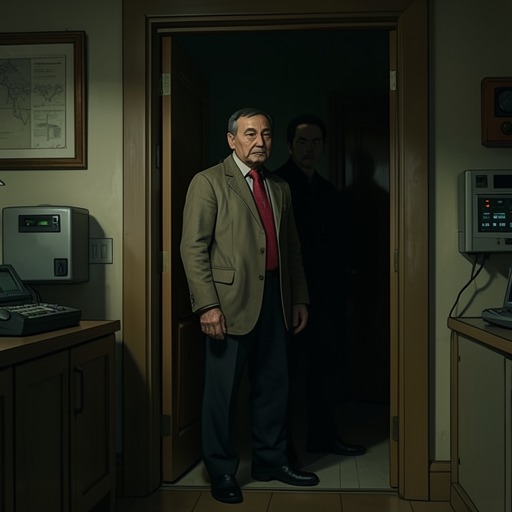
Creta Kano’s third self
The Wind-Up Bird ChronicleCreta Kano’s third self is the new identity she says emerged after her encounter with Noboru Wataya, ending a succession of lives shaped first by chronic pain and then by numbness. The change gives her a way out of that numbness, but not an immediately complete or settled sense of self: she describes herself as a new person and, at the same time, as an almost empty container whose identity must be built through experience. Her account makes rebirth neither a clean rescue nor a finished transformation; the new self carries both a direction toward greater vitality and the unresolved burden of the circumstances that brought it into being.
Emergence After the Earlier Selves
Creta describes the change as following an interval in which she felt disconnected from her body and unable to direct its movements or sensations. After several days, she says, the disorder quieted, and she recognized that she had become someone entirely different. She names this identity her third self, placing it after two earlier states: her original self, which lived with relentless pain, and an interim self that followed her failed suicide attempt. The second state was free of the physical pain that had defined her life, but the relief had come with a pervasive loss of feeling, vitality, and concentration.
The third self therefore marks a significant change without restoring an uncomplicated continuity with the person she had been. Creta cannot say whether the person who emerged was the self that should have existed all along. What she can discern is a tentative sense that she is moving in a better direction. When Toru Okada asks whether the man gave her a new self, she allows that he may have done so: she associates the encounter with an intense physical change and the discovery that she had entered a wholly new container. She accepts that new identity partly because it offered a way out of the numbness that had felt like a prison.
A New Identity, Not a Finished Self
The change does not immediately give Creta a settled knowledge of who she is. She says that she had to learn what this self was through experience: how it functioned, what it felt, and how its elements fitted together. In her account, nearly everything inside her had spilled away, leaving her both new and almost empty. She therefore had to build what she called “I,” making the elements of her identity one by one rather than recovering a complete self that had been waiting intact beneath the upheaval.
Her daily life reflects that uncertainty. Though officially still a student, she had no intention of returning to university. She spent long periods alone in parks, went to the library on rainy days, sometimes passed the day in a movie theater, and rode repeatedly around the city on the Yamanote Circle Line. She felt isolated and had no one to ask for guidance. Malta Kano was away on Malta, and Creta did not know how to contact her. Yet she was not unhappy: the distinction mattered because, unlike before, she had a self to hold on to while she worked out what it might become.
Malta Kano’s Guidance and the Cost of Transformation
When Malta Kano returned, she told Creta that she had been moving step by step toward a more proper state and that the worst of her ordeal would not return. She also insisted that Creta must not forget that the transformation had come through a violation that should never have happened. Malta could not remove its effects or tell Creta how to do so; that work would have to be discovered and undertaken by Creta herself. Her counsel thus recognizes the change as both liberating and marked by an unresolved injury.
Malta gave her the name Creta Kano, explaining that a newly reborn person needed a new name. Creta liked it from the beginning. Under Malta’s guidance, she learned to control her new self and to distinguish flesh from spirit; she also became a spiritual medium. For the first time, she says, she could live with some peace. Her true self remained beyond her grasp, but Malta became a companion, guide, protector, and person who understood and accepted her. The third self could develop in a relationship of support, even though Creta did not regard that development as proof that she had reached a final identity.
From Container to Person
Years later, Creta’s understanding of the third self remains qualified. She says that the new state had initially given her only the minimum container for a self, not a fully formed person. Under Malta’s guidance she had passed many egos through herself, and she came to describe much of her life as existence without a stable, self-directed identity. That retrospective judgment does not erase the importance of the third self; it clarifies the difference between escaping the numbness and becoming able to claim a life as her own.
At the point when she tells Toru Okada her story, Creta says she is trying to establish herself on the face of the earth. She no longer understands herself as merely a container or a medium through which other egos pass. The third self is thus best understood as a necessary but unfinished beginning: it restores the possibility of agency and attachment to life, while leaving Creta responsible for continuing the work of making a self. Its meaning lies in that tension between being newly able to live and not yet knowing what a fully grounded identity will be.